
Opening
The German real‑estate debate is stuck between soaring rents, sluggish renovation and a housing market that’s tugged in opposite directions. The latest GREIX index shows that tenant costs jumped far faster than inflation, while the supply of available flats shrank. Landlords have responded by splitting apartments into tiny, furnished rooms and charging premium rates, pushing regulators to act. Berlin’s ruling SPD now wants to go further, proposing a city‑wide freeze on cold rents and a cap on landlords’ profits for about 1.4 million privately rented flats.
At the same time, climate‑driven renovation is lagging badly. New data show a widening price gap between energy‑efficient and inefficient buildings, yet owners are still reluctant to invest in upgrades. Buyers, however, are seeing new opportunities: demand is recovering, but there are still enough listings on the market that discounts of around 5–10 per cent remain possible.
This week in 30 seconds
Rents jump and micro‑rooms under fire: GREIX data show asking rents up 4.5 % year‑on‑year, roughly double inflation; listings fell and furnished offers hit a record share. Berlin’s Neukölln district banned landlords from dividing flats into 6–11 m² rooms and charging 600–660 €.
SPD proposes rent freeze and profit caps: Berlin’s SPD plans to freeze cold rents for 1.4 million privately rented homes and limit profit distributions, exempting small landlords and new builds.
Energy gap widens: Homes in class A/B sell for 43 % more than G/H properties; class D homes fetch a 23 % premium.
Buyer leverage persists: Demand is picking up, but there are still twice as many listings as during the low‑interest era; price discounts of up to 9 % are realistic. While Millennials are being priced out:
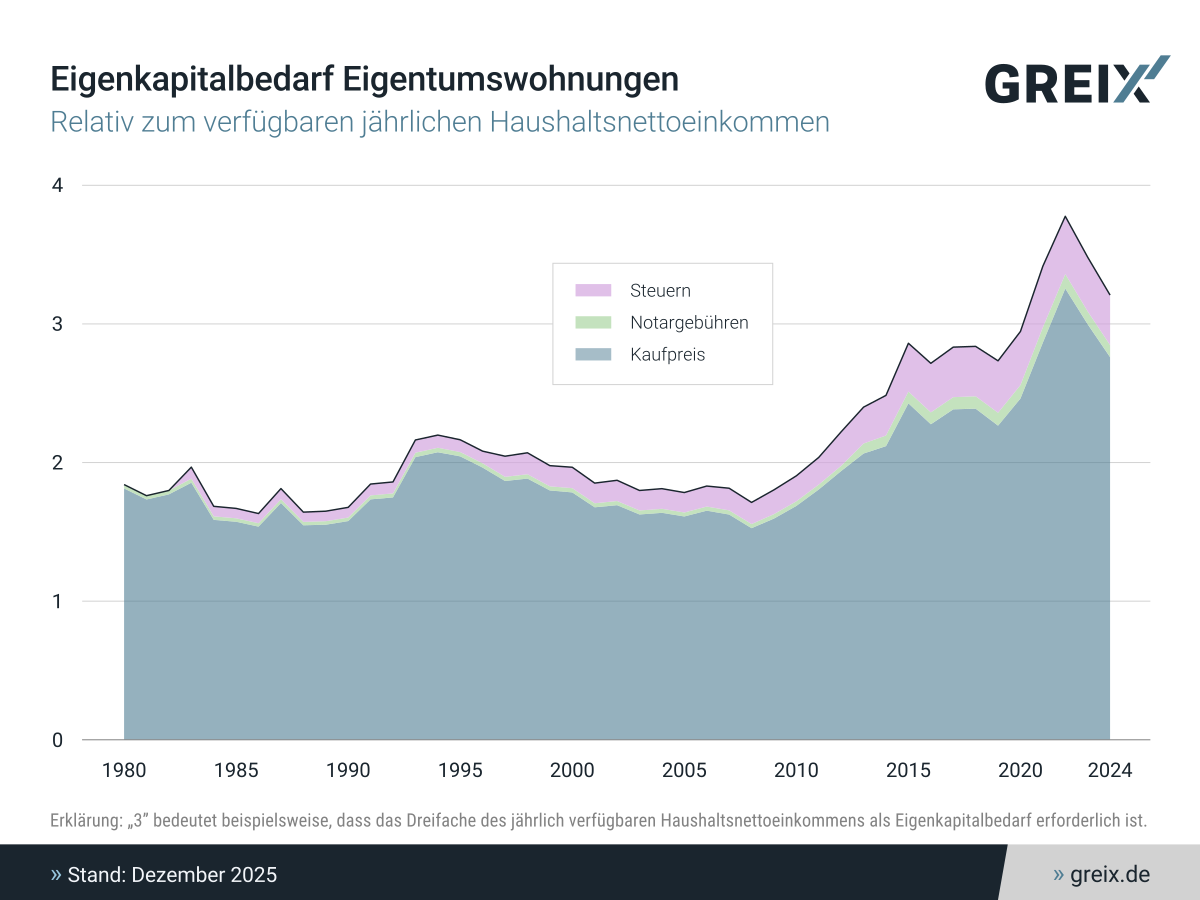
Average required Equity to Annual Household Net Income Ratio for Apartments
1. Millennials squeezed by equity demands
What happened?
A study by the Kiel Institute for the World Economy found that millennials must save nearly 14 years on average to assemble enough equity for a property purchase. Almost 4x the annual household net income is required as a downpayment plus costs.
The main reason is the increased equity requirement driven by the price boom and higher transfer taxes; monthly mortgage costs are less of a factor.
Millennials devote about 25 % of their income to mortgage payments compared with 20 % for baby boomers.
As a result, more buyers rely on family support via gifts or inheritances to buy.
Why it matters:
The German ideal of “Eigenheim” is slipping further out of reach for younger generations. Higher entry costs mean that homeownership increasingly depends on family wealth rather than personal earnings. That concentrates property ownership among those with intergenerational support and undermines social mobility. The study’s call to lower real‑estate transfer taxes is a reminder that tax policy can either widen or narrow generational inequality. Without reforms, the homeownership rate among millennials is likely to remain suppressed, with broader implications for wealth accumulation and demographic stability.

600 euros for 8sqm rooms - Landlords being 🦈
2. Rents jump and micro‑rooms under fire
What happened?
The GREIX rental index for Q4 2025 shows asking rents up 4.5 % year‑on‑year—roughly double the national inflation rate; quarter‑on‑quarter growth was 1.0 % across 37 cities.
Furnished and fixed‑term listings reached 17 % of all rental offers in 2025, nearly twice the share a decade ago; in the eight largest cities, the share is almost a quarter, and in Munich, about one third.
Supply is shrinking: the number of listings fell 7 % versus the prior year and 20 % compared with 2015. Average cold rents range from 23.35 €/m² in Munich to 17.36 €/m² in Frankfurt, well above the national average of 14.41 €/m².
In Berlin‑Neukölln, an owner subdivided more than a dozen apartments into 6–11 m² rooms, renting them individually for 600–660 € per month; tenants pay 600 € for eight‑m² rooms and up to 800 € for 15 m². The district declared the practice illegal and ordered the landlord to reverse the modifications, and other districts are preparing similar bans.
Why it matters:
Tenants are squeezed from both sides: fewer available apartments and accelerated rental growth. Furnished listings and subdivided micro‑rooms can command 30–40 €/m², making them lucrative niches for landlords and burdens for renters. The high share of temporary contracts also implies greater precariousness, as leases often run for only months. Policymakers face a dilemma: crack down on furnished rentals and micro‑rooms to protect tenants, but risk shrinking supply further. Expect debates about stricter disclosure of furniture surcharges and expanded rent‑control provisions—planned regulations suggest surcharges of 10–30 % may be capped and penalties introduced. Court rulings on Neukölln’s bans could set precedents for other cities and may push investors to rethink micro‑apartment business models.
3. Efficiency gap widens as renovation stalls
What happened?
A study commissioned by the Bundesverband energieeffiziente Gebäudehülle (BuVEG) and conducted by ImmobilienScout24 found that buildings with high energy efficiency in Germany sell for about 23 % higher prices than comparable properties.
The analysis covered 155 000 properties (single‑family homes, multi‑family houses and condominiums) across urban and rural regions and various age classes over a 12‑month period.
The price premium is greatest in two segments: energy‑efficient rural properties fetch 31 % more, while pre‑1949 urban buildings see a 44 % price boost after energy‑efficiency upgrades; single‑family houses and condos show similar value gains.
Jan Peter Hinrichs, managing director of BuVEG, noted that efficient renovations not only deliver climate benefits but are also a significant driver of a property’s value.
Despite these benefits, Germany’s building stock remains largely inefficient: of the country’s 22 million buildings, around 60 % are energetically inadequate, consuming more than one‑third of total energy and causing the sector to miss its 2020 climate targets. Hinrichs urged policymakers to improve the framework for modernization to accelerate upgrades.
Why it matters:
These findings show that energy efficiency commands a sizeable price premium, turning climate‑friendly renovations into a clear financial opportunity. Rural houses and historic city buildings stand to gain the most from upgrades, suggesting a particularly strong case for investing in insulation and modern heating systems. By quantifying the value uplift across property types, the study demonstrates that efficiency and profitability can align, providing a strong counter to owners who balk at high upfront costs. Yet the sheer size of the inefficient building stock—60 % of Germany’s 22 million buildings—and the failure to meet climate targets signal a looming challenge. Without rapid improvements to policy incentives and financing tools, a majority of properties risk becoming obsolete in a decarbonising market. Energy efficiency is therefore both a business imperative and a policy necessity.
4. Berlin SPD proposes rent and profit caps
What happened?
Berlin’s SPD wants to freeze cold rents for around 1.4 million privately rented flats; increases would be allowed only in line with the inflation rate.
The measure would apply only to apartments that aren’t already price‑bound and would exclude municipal housing companies, cooperatives and landlords with up to two rentals; new builds are exempt to avoid stifling construction.
SPD also proposes limiting profit distributions by housing companies and requiring landlords to reinvest surplus into maintenance, repairs or new construction. (Return of the DDR, anyone?)
The party intends to base the law on Article 15 of Germany’s constitution; it emphasizes that this is not expropriation but aims to “make the housing market social” by capping rents, curbing speculation and funding climate‑friendly upgrades. Landlords would be partially compensated via a so‑called “Vergesellschaftungsabschlag,” with estimated annual costs of around 300 million € for the state.
Why it matters:
This is the most radical intervention in Berlin’s housing market since the failed 2020 rent cap. By freezing rents and capping profits, the SPD hopes to halt what it calls a “price spiral” and force investors to reinvest rather than extract dividends. Exemptions for small landlords and new builds show an awareness of supply‑side risks, but broad intervention could still deter private investment or prompt legal challenges. Basing the law on Article 15—the constitutional clause allowing socialization of property—signals readiness for a constitutional fight. The proposed digital register and quota for low‑income tenants hint at a broader push for transparency and redistribution. If enacted, Berlin could once again become a test case for radical rent policy, with nationwide implications. I expect that more investors will look beyond Berlin to invest in other areas like Brandenburg.

The German Real Estate Price Index
Impact on prices and signals
Summary:
Upward pressure: Limited supply and rising construction costs mean Germany continues to build far fewer homes than needed. Rents are climbing at roughly twice the inflation rate, and furnished micro‑rooms can fetch 30–40 €/m². Energy‑efficient upgrades deliver outsized price premiums: efficient rural homes sell for 31 % more, and pre‑1949 urban buildings for 44 % more than comparable inefficient properties. Together, these forces suggest continued upward pressure on both rents and values for desirable properties.
Downward pressure: Buyers still have negotiating leverage: discounts of 5–10 % are common, and a significant share of purchasers secure 10–15 % reductions. Younger generations face longer saving periods to build sufficient equity, which could temper demand. Proposed rent and profit caps in Berlin and crackdowns on micro‑room conversions may further restrain price growth in certain segments.
Why it matters:
These cross‑currents underscore a market pulled in opposite directions. Tight supply, climate‑related premiums and rising rents will likely keep upward pressure on prices for efficient, well‑located properties upward. Yet affordability constraints, persistent discounting and aggressive regulation introduce downward forces that could cap price growth or even soften valuations in specific niches. Investors should brace for volatility: the spread between prime and secondary assets may widen further, with efficiency and regulatory exposure acting as key differentiators. Policymakers face a delicate balancing act—encouraging renovation and new construction without exacerbating affordability and equity gaps.
What we’re watching next
Regulation of furnished rentals and micro‑rooms: The federal government plans to tighten the rent‑brake rules for furnished apartments and index leases; draft legislation could cap furniture surcharges and increase penalties. Court rulings on Berlin’s micro‑room bans will signal whether other cities can follow suit.
Berlin SPD’s rent‑and‑profit‑cap bill: Watch the drafting of the law based on Article 15 and the ensuing legal scrutiny. Business groups and federal politicians may challenge its constitutionality, while activists will push for even stronger measures.
Housing supply measures: With construction far below targets and costs rising, look for new subsidies, deregulation or public‑sector building programmes—and for how Berlin’s proposals might affect developer sentiment.
— Nick Mulder // The German Real Estate Brief
A big thanks to my companies =)
Hypofriend.de → Find the right mortgage for your home
Investfriend.de → Invest in Energy-efficient New Builds